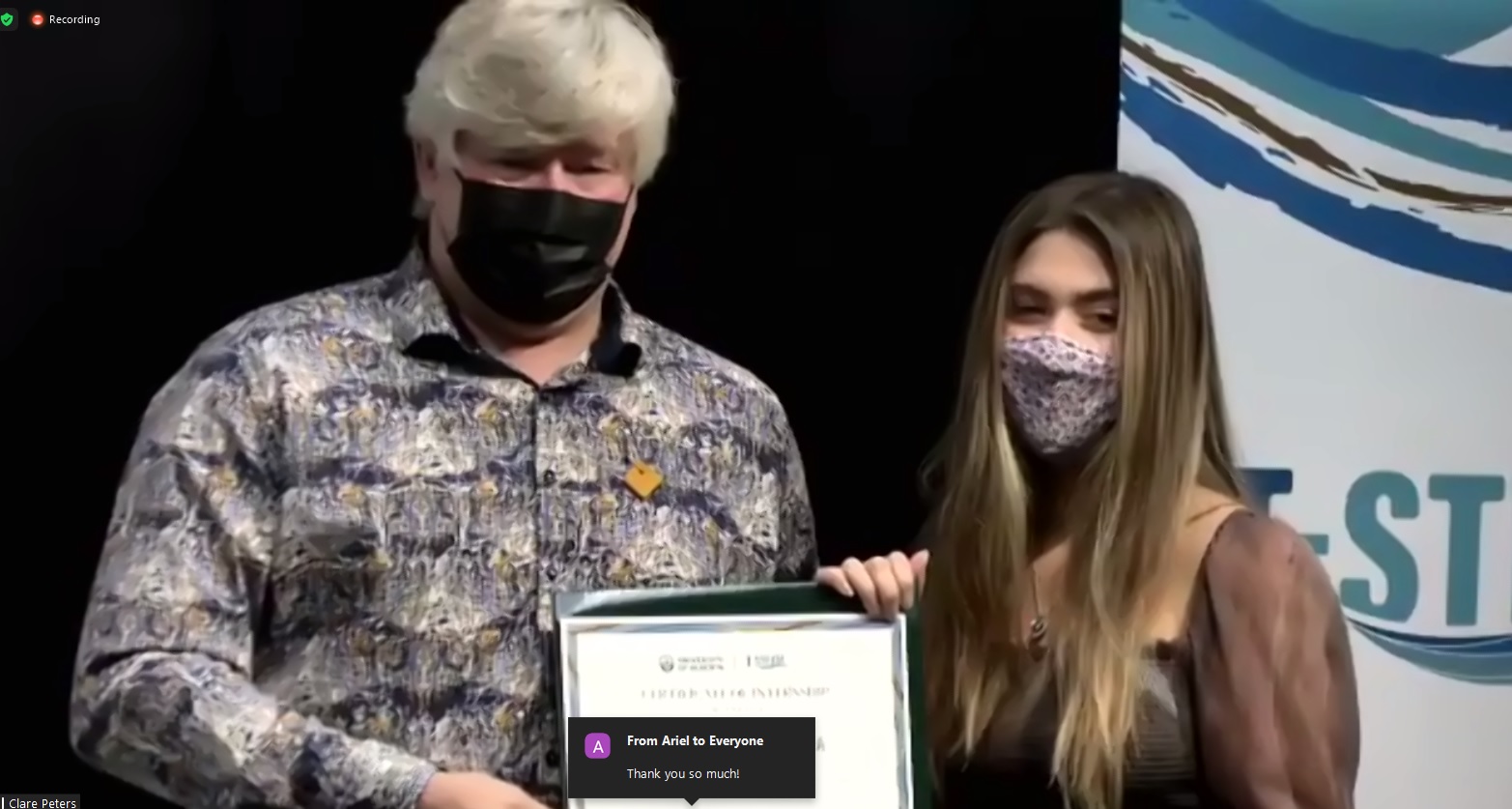
Congratulations to Tianna for finishing her research internship with an excellent presentation at the closing symposium today! I am looking forward to her continued contributions to our group as more exciting research is ahead of us.
Honey Bee Research at the University of Alberta

Congratulations to Tianna for finishing her research internship with an excellent presentation at the closing symposium today! I am looking forward to her continued contributions to our group as more exciting research is ahead of us.
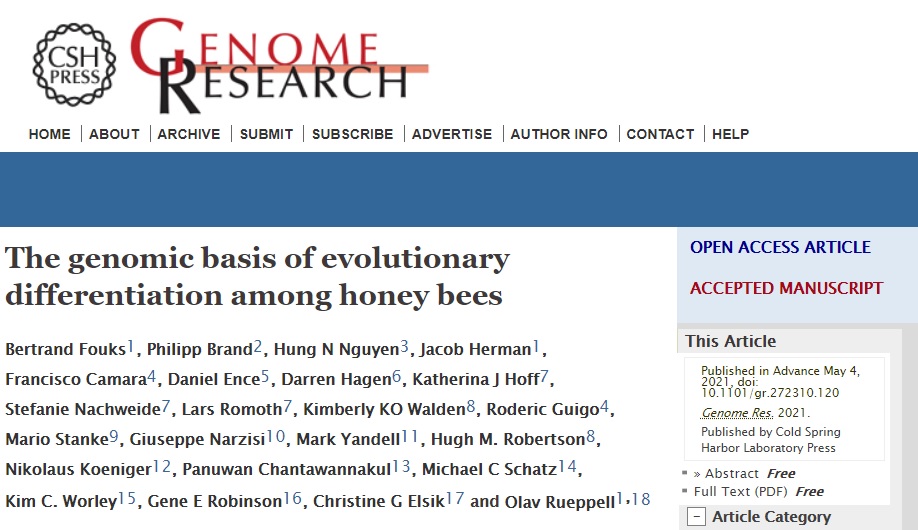
A very long-term project comes finally to a happy ending in the form of a publication. It started with a trip to Borneo with Niko Koeniger, sparking my interest in the Asian honey bees. The genomes of Apis dorsata and Apis florea followed, and now we have them finally analyzed for signatures of selection that might give us some hypotheses about the evolutionary differentiation among the three principal honey bee clades and adaptations that might have occurred during the common evolution of honey bees. I am so glad and want to thank everyone who was involved, including Robert Page who introduced me to Niko!
A thorough study indicating that the neuropeptide tachykinin may regulate how much behavioral specialists specialize… It’s a new angle on the old and long-standing problem of division of labor. Just a reminder that so much more is to be learned, for example the colony-level consequences remain to be tested!
Tachykinin signaling inhibits task-specific behavioral responsiveness in honeybee workers
I am very happy that the study of former MSc student Anissa and current PhD student Jake has appeared in the Phil Trans R. Soc. special issue on Aging in Social Insects: Even though the title doesnt indicate it clearly, the study has some great results with repercussions for understanding the longevity of reproductives in social insects: Reproductive activation in honeybee (Apis mellifera) workers protects against abiotic and biotic stress
The Varroa task-force of the COLOSS network has launched the second phase of the Varroa Citizen Science Initiative to globally monitor for Varroa and compare its impact across the globe. I will act as the country coordinator for Canada and am looking for volunteers to represent Canada from March 2021-March 2023. Please find more information in this document: VarroaCSI_COLOSS. If you are interested and eligible, please email me directly for registration!
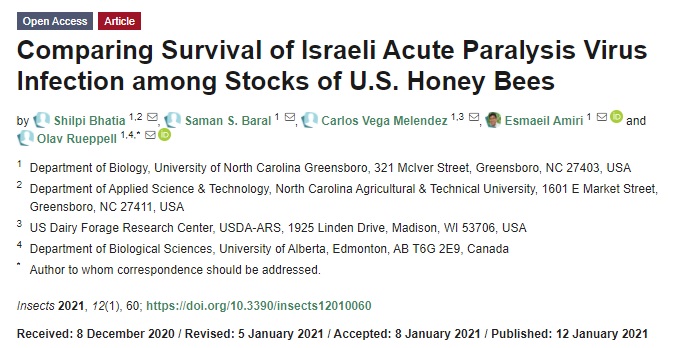
With funding of the Healthy Hives 2020 initiative, we set out to characterize variation in virus susceptibility, as a basis for selective breeding. And we found there is potential within and among breeding operations! We also found a surprisingly heavy viral load in queens, which should caution all of us that queens might not get sick but can be an efficient long-range transmission pathway for viruses. Congratulations Shilpi and all co-authors!
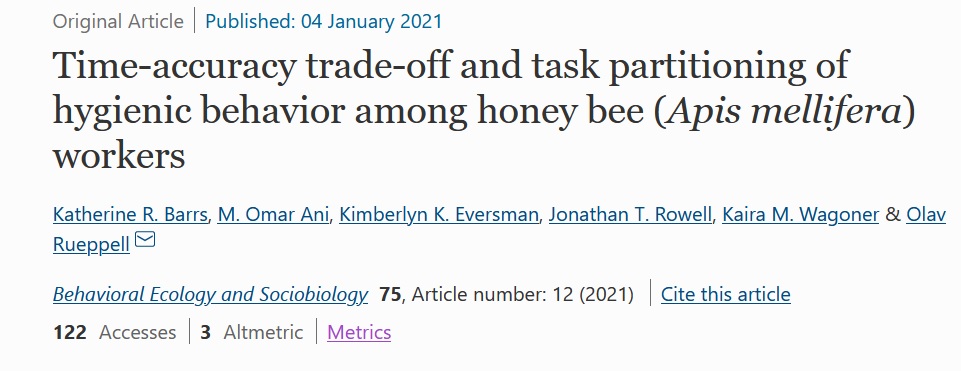
As always, the ABRC meeting was exciting and informative! Amazing plenary talks, but all presentations were great. Glad our group contributed three of them, with Kaira reporting on her new testing of hygienic behavior assays, Esmaeil describing his newest virus experiment to study queen immunity, and Bin Han as lead author on the presentation of his identification of the neuropeptide tachykinin as general regulator of the degree of behavioral specialization in honey bee workers.

A great, interdisciplinary team of undergraduates made this nice combination of empirical research and theoretical modeling happen:
Phoebe successfully defended her MSc defense on group size effects on hygienic behavior. Interesting topics and results with more to come… Thanks everybody involved for making it a success!
The North American Pollinator Protection Campaign celebrates its 20th anniversary. Amazing achievements over the past twenty years, and I am proud to be a part of the honey bee health task force!
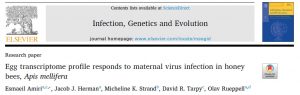
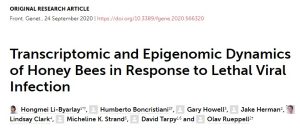
Congratulations to Hongmei Li-Byarlay for publishing our paper on transcriptome and epigenome consequences of IAPV infection in honey bee pupae! And congratulations for Esmaeil Amiri for publishing our comparison of the transcriptomes of honey bee eggs coming from healthy or virus-infected mothers!
I am excited to join the excellent Department of Biological Sciences at the University of Alberta! And I hope to get this site up to speed shortly!