About our Research
The research in the Hall Lab addresses a fundamental and overarching question in evolutionary biology: “what is the basis of morphological diversity?” Historically our knowledge was derived from model species, which has somewhat limited our understanding of important evolutionary processes. An imperative trend has been to expand the comparative landscape and establish focal clades that enable investigation of complex and ecologically important traits not present in model species. Elucidating the origin of morphological diversity requires an interdisciplinary approach combining phylogenetics, thorough descriptions of developmental and morphoanatomical patterns, comparative gene expression studies, and experiments that directly test gene function.
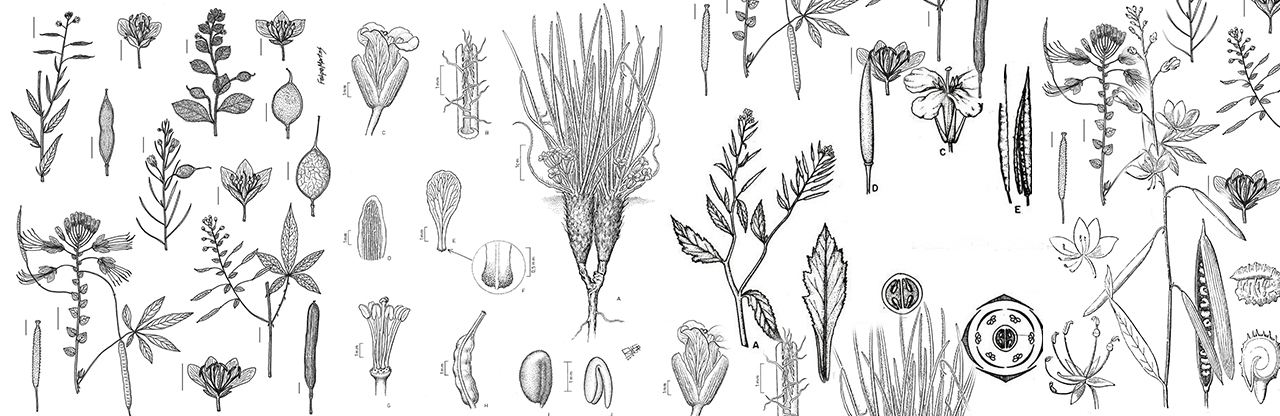
We have been successful in investigating the patterns and processes that lead to floral diversity, focusing on traits important to attracting and rewarding pollinators. We mostly study Cleomaceae (spider plant family), a small family that is sister to Brassicaceae (mustard plant family). Cleomaceae houses considerable morphological diversity, including variation in traits such as floral symmetry, perianth color, and organ number and elaboration. Our lab and collaborators established the phylogenetic framework of the order and family. We also investigated floral nectaries, the structures that produce the complex sugar-rich reward called nectar. We have documented across family patterns of nectary morphology and anatomy and UV-fluorescent nectar. We have also published a protocol for virus-induced gene silencing, which is a powerful method for determining loss of function phenotypes for genes of interest. We used this to establish the genes responsible for nectary development and nectar secretion in Cleome violacea. We have also conducted an in-depth analysis of the development and genetic basis of the androgynophore (stalk to reproductive tissue) in Gynandropsis gynandra. Across these papers and others, we have used comparative transcriptomics to provide insights into the evolution of ecologically important traits. In sum, we continue to build a synthetic picture of Cleomaceae flowers by interweaving developmental, morphoanatomical, phylogenetic, comparative gene expression, and functional methods.