|
ARTHROPODA (IV): Crustacea (Crustacea study images;
|
 Previous Home Next
|
|
ARTHROPODA (IV): Crustacea (Crustacea study images;
|
Previous Home Next
b) head covered by a shield: a carapace (a structure) may extend over some or all thoracic segments, yielding a cephalothorax(body region)
c) some thoracic segments may fuse with the head and their limbs modified as maxillipeds for feeding; walking legs= periopods
d) abdominal segments may or may not have limbs (pleopods)
e) primitively had an elongate body and many similar biramous legs
b) lifestyles: most are free living; 3 classes have a number of parasitic species, and one subclass (Cirripidea) is entirely sessile as adults
c) body size: generally small (<20 mm) in most classes/subclasses, but large size (>100 mm) occurs in three subclasses
d) classes are distinguished by: number of tagmata, number of segments per tagmatum, number of thoracic segments covered by a carapace, number of segments fused with the carapace, and presence/absence of movable spines (rami) on the telson
e) most diverse class (Malacostraca) share 3 characters: i) 21 somites, ii) stalked eyes in adults, iii) limbs on abdominal segments; 3 general body forms: shrimp-like, lobster-like, crab-like (multiple origins)
b) filter feeding at small size is difficult because of high viscosity: water has no momentum, 'wall effects' are large, flow is totally reversible
c) in fairy shrimp a filter box generates high pressure that forces water through a sieve of setae; other small species use similar methods
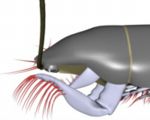 |
For some spectacular computer animations of the form, and of the
swimming, escape, and prey capture behaviors of the predatory copepod Euchaeta, see the Virtual Copepod Page. |
Copyright (c) 2012 by A. Richard Palmer. All rights reserved.
(revised Dec. 31, 2011)