Condensed greatly from Tree of Life for taxa covered in Zool250
TRAITS MAPPED ON ABOVE TREE:
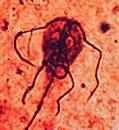
(diplomonad)
BASAL EUKARYOTA
(P/B refers to Pearse/Pearse/Buchsbaum/Buchsbaum, 1987,
Living Invertebrates)
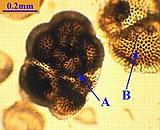
(foraminifera)
=================== Prokaryotes
<<===|
| ==D=========== Diplomonads (P/B phylum Metamonadida, zooflagellate, Giardia)
==E==|
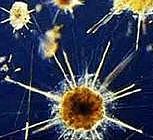
| ======== "radiolaria" (P/B phyla Acantharia; Heliozoa); actinopod sarcodine
==Mt==|
======== Granuloreticulosa (foraminifera); rhizopod rhizopod sarcodine
|
================================== TO CROWN EUKARYOTES ===>
|
D= ancient retrotransposon (Burke et al. 2002 Mol. Biol. Evol. 19:619)
E= Eukaryotes: mitosis, membrane-bound organelles including: nucleus, rough endoplasmic reticulum, golgi apparatus?, lysosomes?) Mt= mitochondria |
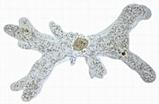
(amoeba) |
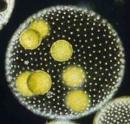
(Volvox) |
CROWN EUKARYOTES
(condensed from
|
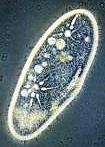
(paramecium) |
(radiolarian) |
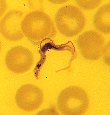
(trypanosome) |
=======B,G,M====================================== TO METAZOA ===>
=DCh=|
=O==| ==== Choanoflagellata; zooflagellate
| |
| ===M===== Fungi (mushrooms, molds, yeast, etc.)
====|
| ============= Amoebozoa(Amoeba, slime molds); rhizopod sarcodine
|
| ===== Chlorophyceae (unicellular green algae; Chlamydamonas, Volvox); phytoflagellate
<<| ===|
| =Cp=| ==M== Embryophytes (land plants)
| | |
| ===| =====M== Rhodophyta (red algae)
| | |
| | ============ Glaucophyta (contain symbiotic cyanobacteria)
| |
| | ==N==== Ciliophora (Paramecium, Stentor, Spirostoma); the ciliates
==| |
| =A=| =Cp== Dinoflagellata; phytoflagellate
| | ==|
| ===| ===== Apicomplexa(Plasmodium); sporozoan
| | |
| | ==M,Cp,S== Stramenopiles (incl. P/B phylum Diatomae= diatoms, brown algae & other taxa)
==|
| ==Cp== Euglenida (Euglena); phytoflagellate
===E===|
====== Kinetoplastida (Trypanosoma); zooflagellate
TRAITS MAPPED ON ABOVE TREE:
|
A= Alveolates: cell surface underlain by many adja-cent sacs or alveoli; tubular mitochondrial cristae
B= blastula Ch= choanocyte (monociliated cells with ring of microvilli around flagellum & distinct flagellar vane) Cp= chloroplast D= diplosome (microtubular flagellar root) E= Euglenozoa: 1 or 2 anterior flagella, discoid mitochondrial christae G= collagen M= multicellularity N= micro- & macro-nucleus O= Opisthokonta: posterior flagellum on motile cells S= unique 3-part mastigonemes in flagella |